Friday, May 22, 2020

'CyberWar'​ in regards to the tension in Nepal - as portrayed by the media and my take on this.

From my understanding, recent changes in the political tension between the two neighboring sides have been gaining heaps of local and international attention these days. The public is always curious and always will be curious to better understand the next move from both the neighboring counterparts. When it comes down to the 'cyber side' of the tension, I always find it fascinating to explore what's beneath the "talk of the town".

So, there were a couple of web page defacements happening in the background when this political tension is still being decided.

If you have been active in the infosec domain between these regions then the web page getting defaced is not really a new topic. It has been more like a normal routine is what I would say. Every other day, there are hundreds of website and servers getting hacked and defaced (which can be accessed through various public mirrors such as Zone-H and Archive records).

Now, coming back to the view. From what I see, a couple of web pages getting defaced by the southern side and the retaliation by some self-proclaimed cyber wizards (aka. The Script Kiddies) is just another lockdown effect on their tedious cunning cyber mind. "Cyber War" is really a cheap word to use as of now. I would more likely argue and disregard a couple of IT media houses alongside some of the self-proclaimed cyber pro bono journalists with extremely minimum research at their end. To speak out frankly, some of them just want a few spicy toppings on their daily news to generate more views and generate revenue through their AdSense account or so on, and nothing so far has been captivating.

The curiosity now boils down to the question, "Are we ready?". A simple answer is, No.

Let me get this from the top of my head.

Did we ever try to take security seriously and invest? Uh, probably, 'seriously' - doubtable. Did we ever try to invest in the security at the CD pipeline or on the SecDev lifecycle and continue to do so? Uh, pretty rare. Did we ever make a nationwide investment in offensive and defensive capabilities? Uh, maybe. Uh, maybe not! Or, maybe we will do it tomorrow. Alas! the "tomorrow" never came.

One of the old articles published by a Nepalese print media on "Cyberwarfare: How prepared is Nepal?" from 2017 can be found here (https://thehimalayantimes.com/opinion/cyber-warfare-how-prepared-is-nepal/) and is still relatable. There might have been some minor changes, people might have been more aware as of now. But personally, I do not still see any major changes.

The recent attacks on some high profile Internet Service Provider (ISP), attacks on some well know startup-ish organization, attacks on some endpoint of a high profile Class-A commercial bank, citizen's data being found and being made publicly available, and then the consistent data leak of thousands of users! Probably it could be an overly excited skiddo running their automated tools who brought this down, publicly made their laughable statements and yet the cyber branch never opened up in regards to their forensic investigations. You see what I see right?

That's pretty much the answer!

Nepal's VNY2020 Campaign - The Cyber Metaphor.

Nepal is expecting at least "500,000 Chinese tourists", "at least 150,000 British visitors", "target of 2 million tourists" and much more. In Nepal, the year 2020 is marked as a campaign 'Visit Nepal Year (VNY) 2020' as the program/campaign is organized to promote tourism in Nepal. The quoted numbers above are just an example and the visitors are expected from all over the globe. Let's not forget the patterns, facts, and trends of "Hacker Tourism" that have been seen rising remarkably in the previous years.

Let's just take a hypothetical assumption where there will be cyber guys willing to disguise through the border, bypassing the border forces, get inside the soil, and potentially eradicate the Cyber Economy. The assumption could be theoretically proved wrong, however, it couldn't be disregarded either. In fact, there could already be a handful of APT groups planning to proxy their route via Nepal, roll their hax and skedaddle through the foobar into the thin air! There are threats and the threats for the cyber side of VNY2020 are for 'real'.

Let us all keep an eye out for the potential cyber warriors unloading their skillset onto the VNY2020 campaign. Let's not give us a chance to read the "Mega Breach" news titles popping all over the pages and the internet this year. Let's not fall a cyber victim and watch out for potential moves in an amenable way.

Source for italic quotes:

1. https://www.nepalitimes.com/banner/chinese-tourist-influx-to-nepal-in-2020/

2. https://www.nepal24hours.com/visit-nepal-2020-campaign-kicks-off-in-uk/

3. https://www.nepalitimes.com/business/turkish-and-visit-nepal-2020-sign-mou/

(Originally, this article was published on January 6, 2020.)

Saturday, October 5, 2019

The weakest link in the infosec chain - Humans?

Vendor Email Compromise (VEC), Business Email compromise (BEC), Phishing attacks, Whaling attacks - you name it. Everything eventually points back to humans and we are all targeted in one way or another. This is a well-known adage in the information security domain that 'humans are the weakest link'. Our thoughts, emotions, innocence - can be easily manipulated by an external entity the way they want. However, the manipulations would/could totally depend on various factors and on any given situation. Nonetheless, this does not necessarily mean we can do nothing about humans and rather invest in the implementations of fancy gadgets - firewalls, heavy/hardcore devices, spam protections/filters, endpoint protections, HIDS/HIPS, and anything as such. Defense in depth is a good strategy, however, doing this does not mean that you are 'free from risk', it simply means that you are trying to 'shift the risk'. Yet, at some point in time, the risk would have the likelihood of getting exploited.

Say, for instance, you implemented all the fancy and hardcore devices, endpoint protection mechanisms, everything in place - to prevent/combat such attacks/issues and then think that you are now protected, everything is in place, everything is now sorted - right? I would highly argue, that you are still not in the state of maturity to combat other evolving threats. The threats to Bring your own device (BYOD), bring your own phone (BYOP), bring your own personal computer (BYOPC) - which still does exist and is, in fact, growing rapidly. Making sure that people understand the technology they are working with and they work on the defined procedure is the least any organization can do.

The attack vectors might differ - a phishing link on the email, an attachment with an embedded backdoor, a malicious app for cell phones, and/or a QR code embedded with malicious link/attachment, drive-by download attacks, vishing, smishing - the list goes on. An attacker with malice intent would always find a cunning way to make you perform the act that might not be of your best interest. Therefore, being aware of the evolving threats, training the people on different attack vectors, and most important - understanding the security culture/practice is definitely a good start.

Humanity still does exist. People still do care about others, they care about things, they care about their priorities, they care for the things that matter to them the most and eventually get kind enough to fall for a lured trap that they might not be well aware of. Let us take it this way - at some point in time, you might fall for it, you might become the weakest link. What does actually matter is, let us all stop stating that "There is no cure for the human's stupidity". Let us all focus on the fact that "stupidity" only exists because of "Ignorance" / "Illiteracy - on the subject matter". Therefore, do not train your employees to not click on the link. Train them on how to spot them, how to spot the difference, how malicious people operate and will try to manipulate the thoughts - so that they can develop the awareness required to spot the difference with maturity - on any given instances.

Attackers do not operate on a 9-5 office hour schedule, 5 days of work and then take days off. If you are training your employees to just not click on the link and you want to protect your business - let me please remind you that you are probably playing it wrong. Do not train your employees to keep your business safe - train them to act safe and spot the differences and they will eventually keep your business safer, even outside the business hours.

PS: Thanks for taking the time to go through this post. Any thoughts on suggestions/criticisms/appreciations are highly appreciated.

Sunday, December 2, 2018

How vulnerable could the internet be - From BGP perspective

The internet that we know of is an interconnection of networks. The networks - managed by organizations, giant corporate, internet service providers (ISP), network service providers (NSP), cross countries internet exchange points (IXP) and various Regional Internet Registry (RIRs). The network traffic that flows across inside, through those various organizations, providers and points are generally managed, delivered and/or received and is generally handled through the protocol - a set of rules, usually known to the world as the Border Gateway Protocol (BGP). If someone with a malicious intent would try to break and/or manipulate this specific protocol (BGP) then that malicious attacker/party can possibly manipulate the traffic flowing in the internet as a whole.

BGP is basically used to interconnect, exchange routes and sharing reach ability information as a standardized exterior gateway routing protocol. Each entity is uniquely identified by it’s Autonomous System (AS) number. Technically, BGP works based on the best path selection algorithm to select the exact match although there are various different criteria such as weight, local preferences, neighbor count etc. For example let’s say Google is using 172.168.0.0/20 to announce the world that it is their network and on the other hand Someone is using 172.168.0.0/24 to announce the world that it is their network. So now, the traffic destined for 172.16.15.14 would go to Someone instead of Google if the information sent by Someone is accepted by the neighboring network and also if the information is further propagated across the internet. When the communication between different AS is either misconfigured or at cases hijacked, this specific chaotic scenario is then known to the world as Prefix hijacking and/or can be interpreted as BGP hijacking. The above example simply is not just a hypothetical scenario, these types of threats do exist in the internet. The case of AS 7007 incident in 1997, Pakistan hijacking the entire YouTube network in 2008, Chinese ISP hijacking the entire internet in 2010, Canadian ISP hijacked to heist Bitcoin and other cryptocurrency in 2014, Russian telecommunication companies hijacking the network of US tech giant companies multiple times including the MasterCard and Visa card network in 2017 and lately the incident of Google Cloud’s traffic being routed to Russia by the Nigerian ISP. A simple misconfiguration and/or a malicious intent in just a single protocol can create a chaos in the internet. According to some sources various state sponsored hackers, government agencies and private organizations have been found to have been doing so (traffic hijacking) for performing large scale man in the middle attack, traffic monitoring and/or for censorship.

Although security experts argue that BGP is never secure, instead a new protocol should somehow be introduced. Nevertheless, there are techniques like using RPKI (Resource Public Key Infrastructure) to sign the AS numbers with a cryptographic signatures, using Resource Origination Authorization (ROA) to associate the address prefix to the AS numbers and various others. As long as the technologies are not used and tuned properly, placing fancy technologies in place and not making use of them would never guarantee security and would always break the Confidentiality, Integrity and Availability of the system and/or Authenticity of the traffics across the network as a whole.

Sunday, November 18, 2018

A lazy night CTF party - Vulnhub - (box Matrix: 1)

Okay so, I had downloaded this (Matrix 1) box a week back or so but due to some random busy-ness I just could not start to give it a shot. Also the thing is that, I usually don't engage myself more into CTF's but when I feel extremely bored - like super bored then I just try to give myself a chance to engage into something interesting and learn new techniques. Anyways, let the story begin.

It all started with a virtual boot up of the recently downloaded virtual machine's OVA file.

As described in the release information for this box, it said "Matrix is a medium level boot2root challenge." Furthermore, "Difficulty: Intermediate" and "Your Goal is to get root and read /root/flag.txt". Intermediate level - Sounds good to me, lets continue.

A quick SYN scan of my network with 'nmap -Pn -sS 192.168.1.0/24 -v' gave me  an information of the host running on port 22, 80 and 31337. Looking further down those port with '-sV' option gave me more detailed information on the services running on those ports. So, it seemed like an OpenSSH and Python SimpleHTTPServer was running.

Opened the browser, on the host IP on the web (HTTP - port 80) - showed me a simple looking web page with not much information but with some fancy looking Matrix message that said "Follow the White Rabbit" "Welcome to the real world, Neo. I'm glad you're here." I thought for a while, Okay! So, where's my White Rabbit? A Quick CTRL + U and I got to see something like '<div class="service"><img src="assets/img/p0rt_31337.png"/ width="15">'
This information here seemed interesting! I knew earlier that the port eleet was open, should be something related! For a couple of minutes I thought that this PNG here could have some hidden information (maybe something to do with steganography?) But no, my conscience was wrong.

I followed the White Rabbit for now and jumped to the port 31337 from my browser. Now, I see a new page with some other fancy looking message. Just by looking at the heading 'Cypher' I had in mind that this could now have something to do with deciphering the message or so. I then performed a quick CTRL + U and now there's that! '<!--p class="service__text">ZWNobyAiVGhlbiB5b3UnbGwgc2VlLCB0aGF0IGl0IGlzIG5vdCB0aGUgc3Bvb24gdGhhdCBiZW5kcywgaXQgaXMgb25seSB5b3Vyc2VsZi4gIiA+IEN5cGhlci5tYXRyaXg=</p-->' My instincts were right! "A long fancy looking text that ended on an equal to (=) sign could be a base64 encoding or so." - I said to myself. It indeed was a base64 encoding. The message was "echo "Then you'll see, that it is not the spoon that bends, it is only yourself. " > Cypher.matrix"

This made me feel like, "something is echoed into Cypher.matrix" and then I sent a GET request to /Cypher.matrix and yes, something was there. I was indeed following down the rabbit hole.


Inside the Cyher.matrix was a complete chaos, a disaster, all the operators, operands, brackets and signs were floating around in-front of my eyes. A quick search on regarding the use of these characters "+, -, <, >, [, ], (, )" took me down to information leading to Brainfuck. Sorry, did I said something inappropriate? No, let's continue.

So, it was basically an Esoteric programming language. After getting an insight of this information. I decoded the message that said "You can enter into matrix as guest, with password k1ll0rXXNote: Actually, I forget last two characters so I have replaced with XX try your luck and find correct string of password." Okay so, seems like we are now getting deeper inside the rabbit hole! But we still don't have the full password to the system.

So, I used the command as "cat /dev/urandom | tr -dc 'a-zA-Z0-9' | fold -w 2 > char-file" that would generate 2 characters long alphanumeric characters and output the list of all those characters inside the char-file. And from that file, I created a dictionary file for my bruteforce since we already knew that the SSH port was open.

"awk '{print "k1ll0r"$0}' char-file > password-list" would now create a password file that would be helpful for bruteforce.

I knew that metasploit is helpful in this case and fired up a shell and used msfconsole and used 'auxiliary/scanner/ssh/ssh_login' module. Username guest,  my dictionary file and a wait for couple of minutes and bang! We now have a matching password and a session opened for us. An interaction with the session we just established as 'sessions -i 1'. A python spawn shell and we're in! We now have a working shell in the box!


I then listed the present working directory from the shell and saw that there's one unusual directory prog. 'Prog is a short for Programs, it probably should have an executable program and maybe I can reverse that program and spawn a root. Or maybe the executable has misconfigured access permission or something as such' is what I thought at the moment after noticing the Prog directory.


Excuse me, did I just saw a vi? 'vi is a text editor, it has always helped people to get down a root shell, am I getting luckier? or is the white rabbit calling me?' is what I thought again. I then opened a vi editor. ":/bin/bash -i" and bam! I then get a full fledged guest shell on the box from my python spawn shell.


Our goal is to root the box, collect the flag and move on. So looking for the allowed sudoers command with 'sudo -l' showed something like "(ALL) ALL". How cool is that? "sudo /bin/bash" - enter the guest password that we previously found and bingo! We're now root and officially pwn the box.


Cat the flag and we've got it!


Anyways, Matrix1 was interesting. I hope to follow the white rabbit more deeper down the path in the upcoming days. Thanks unknowndevice64 for building the matrix!


'I know what you're thinking, 'cause right now I'm thinking the same thing. Actually, I've been thinking it ever since I got here: Why oh why didn't I take the BLUE pill?' or 'Perhaps we are asking the wrong questions.'

Thursday, June 28, 2018

Our information in this era is in a perilous state! - (PageUp Security Breach)

We have heard a lot of gossip about the latest security breach suffered by companies like PageUP and Flightradar24 last month. The cyber havoc suffered by the human resource management company or so as to say ‘Cloud based Software-as-Service’ provider pageup is now on a limelight.

As mentioned in the official page of 'PageUp', "PageUp delivers HR software that helps your employees reach their full potential, anywhere in the world." So, various industrial sectors including corporate organizations, financial organizations, universities, healthcare group and other such organizations which included Reserve Bank of Australia, Commonwealth Bank, National Australia Bank(NAB), Australia Post, Australian Broadcasting Corporation (ABC), Medibank, Australian Red Cross, Bupa, University of new south wales (USNW), Australia National University(ANU), Macquarie University, Charles Sturt  University (CSU), Lindt, Australian Gas Light (AGL), Tatts group, Aldi, Wesfarmers group’s acquisition including Coles, Kmart, Target, Officeworks and various other such organizations were dependent on the HR management service provided by the PageUP and were a part of the security incident that occured on May.

The immense use of online internet based systems has made our work easier and time saver at most of the cases. These types of online based systems have gave us many opportunities and made our work efficient, however they have always lacked something or the other and in this case, it was ‘Security’. The ‘Trust’ that the users have on these type of online based system is tremendously high. People feel safe and share their private informations with some third party thinking that their information is in the right hands and these companies would safeguard their information. Nevertheless, this has not been the case. Private and crucial information including email id, passwords, date of birth, phone number, physical home address, nationality, passport numbers, driving license numbers, card details, bank details, tax file number, superannuation details, past and present employment history and others such information could have been exposed to the cyber criminals in the recent breach.

Any information that we hold and share about us is very critical either it be our date of birth, home address, phone number, email id, personally identifiable information(PII) including citizenship id number, passport number, license number, tax file numbers, bank account details and others such information could be used against us to cause a harm either physically or virtually.

So, what would cyber criminals do with my personal information?
This could be the curious question that most of us might have in mind. Well, the cyber crooks are surely to generate huge sum of money from such compromised personal information. Phishing, vishing or smishing scamers are mostly likely willing to get such information for various fraudulent activities. Advertising companies might want to get such information to target their advertisement to a specific group of people living on certain locality or such. Criminals might use such financial information to extract money online or physically. Cyber crooks might sell such data to criminal gangs and create identity theft and cause severe catastrophe on an individual's life. If such similar evilness would happen then, sky's the limit for those crooks.

Technically speaking, such critical personal information of an individual on the dark web is worth nothing more than five dollars, and yes there are peoples who are interested in buying these informations.

People might be able to change their usernames, passwords, email id, people might change their bank card details but information like date of birth, mothers maiden name, their working history(resume informations) these are like the biometrics - fingerprints; nothing can be done neither can be changed, once it is gone is gone forever. Until and unless we do not create a cyber aware netizens, make use of proper technologies in a proper manner, these sort of activities would never stop from happening.

In conclusion, PageUP was just another example. There could be thousands of such similar organizations that provide such services and hold critical personal information of millions of people. Still, hundreds of them could be vulnerable to similar hack. Lets not forget that, Ashley madison, Equifax, Cambridge Analytica and others such breach were once a history. If even after all these years of lessons we have learned and cannot safeguard the information of individuals who completely trust and provide their details to such companies, and in the end
their trust gets exploited into the blue then all of our presence in this virtual world of computer networks could be doomed.

Are other such companies, private and government organization working hard to protect their netizens private data?

Finally, the question is that “Is our information in this era, in a perilous state?”

Monday, April 30, 2018

Cyber kill chain - Oh what a fancy thing it is!

Lets say, I manage a network. My system was publicly accessible and someone has managed to exploit the vulnerability in the system using a MS17-010 (EternalBlue) exploit. I, as a network manager, I can see some egress traffic on my SMB port and now found that my system is communicating with an external IP address (possibly someones Command and Control server).

The question is, What do i do now?
Should I call the Incident response team that does not even exist? Should I shut down the whole network? Should I start to read my organizational policy so as to figure out what am I supposed to do or Should I  start to cry since the attacker could be planning to inject WannaCry or so into the network?

That's exactly when you would require a Cyber Kill chain.

So, What exactly is it?

Cyber kill chain is basically a framework that is part of the intelligence driven defense model for identifying and preventing the cyber intrusion activity. It is also commonly refered to as a cyber attack lifecycle that would help identify and prevent the intrusion. The actual model, the Cyber Kill Chain framework, was developed by Lockheed Martin and is commonly used for identification and prevention of cyber intrusions.

Should I even care about the Cyber kill chain?
If you are an organization/individual that maintains and manages the in and out flow of the data... In short, ya; sorta!

Lets get back to the thrill, the Insight of an attack:

Usually, every attack starts with passive recon, active recon and then the real attack happens then after, the attacker then expands the attack surface, exploits, starts the post exploitation phase, creates backdoor, exfiltrates the data and clears the track. Lockheed martin defines these phases as Reconnaissance, Weaponize, Delivery, Exploitation, Installation, Command and Control, Actions on Objectives.

Source: Lockheed Martin

As said earlier, in the imaginary network that I manage, as the successive events the attacker then creates a new backdoor, and is now scanning the internal network for their lateral movement. The attacker gets access to my internal database server or so, exfiltrates the data, tries cleaning the trace and run away fulfilling their need for now since they already have backdoor which they can now access at anytime they want.

This is just a simple idea of what could happen here, there could be hundreds or maybe thousands of possibilities on what the attacker might be doing or wanting to do depending on what information the organization/individual hold and as per the motive of an attacker.

At some cases, sophisticated attackers as in APT attacks, the attackers do not follow these steps, they sometime skip the steps or add their own steps making the real attack just a diversion and finding the real attacker information would be like a needle in a haystack. For example, a ddos attack could be used by attackers as a diversionary manoeuvre for creating immense amount of events in the log making the actual event harder to find.

The cyber kill chain helps to prevent and suggest preventive measures depending on these different stages. To break the chain, if there is an event or if there is anything that seems suspicious, start digging onto it. If you feel that it is a genuine attack that is happening then triage the incident. Figure out how the attacker got inside the system or maybe how the attacker is trying to get inside the system. To stop the possible future damage, gather the forensics investigation / incident report and try figuring out the way to stop these type of future attacks. There are certain technologies that help in killing the attack chain like antispam, web filtering, intrusion prevention and detection, antivirus, SIEM, DBAM, next generation firewalls, data loss prevention technologies and others such.

Again, my question to you; Should you care about the kill chain?
You may say: I do not own any information, I do not have any data as such, or I do not have anything at all. So, why should I care!

For example at most of the cases, the attackers might not be interested in a large scale data or high profile servers or anything as such. These small compromised resources can be used to commit advertisement fraud, spread misleading information/news or send out spam, extort the company for ransom or sell the data that they have acquired on the black market, or even rent out hijacked infrastructure to other criminals as in sell these servers for providing ransomware as service, DDOS as service or others such.

The goal here is not just to know the 'Cyber kill chain'. You know it, great! What are you waiting for? Implement it.. follow the kill chain model and gotta catch them all!

PS: To stop an attack, you need to think like an attacker.

A little bird once told, "Know the enemy and know yourself."

Monday, August 7, 2017

SMBloris is in the town and Microsoft won't provide a patch for it!


SMB is having a very hard time lately. NSA’s exploit under codename Eternalblue/Double pulsar, Wannacry Ransomware, Uiwix Ransomware, Adylkuzz and others were all taking advantage of the SMB exploit. The new exploit for SMB was released at this DEFCON25 by security researchers zerosum0x0 and JennaMagius as a zero day. This security vulnerability is named as SMBLoris which is named after the Apache Web server bug exploited by Slowloris in 2009. Both SMBloris and Slowloris attacks can use a single machine to crash or freeze a much more powerful server, however Slowloris unlike SMBloris targets webservers. As of now, Microsoft has refused to update any patch for this specific vulnerability saying that it was just a moderate issue and also would likely never be fixed. This bug allows an attacker to remotely crash Windows server with only about 20 lines of Python code and a portable system such as Raspberry Pi.

What exactly is the bug?

The vulnerability exists in the way SMB packets are processed and system allocates the memory for the process. SMBloris is basically a memory-handling bug which if exploited forces a server hosted on the Internet or at the local network to remotely allocate 128KiB of non-paged physical memory that has to be reserved and can't be swapped out for every connection to the service. An attacker execute this attack by sending three bytes to the SMB service with the 17-bit NetBIOS Session Service (NBSS) length field set to the maximum. The kernel keeps the connection open for 30 seconds and then gives up. So for every 30 seconds, 128KiB of memory is tied up for every connection attempted.

Although, the well known TCP port for NBSS traffic is 139 an attacker now execute a connection request for every single TCP port which are possible i.e. up to 65,535 ports and thus potentially consume up to 8GiB of non-paged RAM for half a minute which would then directly hamper the performance of the machine since the kernel is forced to clean the system for any free memory as more allocations arrive. Now, if an attacker launches this attack on IPv4 and IPv6, the memory burden rises to 16GiB, and if an attack then comes from just two IP addresses, it can fill upto 32GiB and so on. Eventually, the target system/server would not be able to allocate memory and hence would freeze and would needs a manual reboot. It would not even crash or show up the blue screen of death (BSOD) since it would have no resource left to show up the blue screen, therefore it will freeze and would never return back from the frozen state untill rebooted forcefully.

Which versions of Windows are affected?

The vulnerability exists in all modern versions of Windows. It exists in at least from Windows 2000 through Windows 10. No matter if all versions of SMB are disabled, all systems are still vulnerable.

Is Samba affected?

Samba is a free software which is re-implementation and an alternative to SMB for other operating systems. It is also vulnerable in a default installation however, it has a workaround.

Workaround: Setup 'max smbd processes = 1000' in smb.conf (normally found under /etc/samba).

What could go wrong?

Cyber criminals in the black market working to provide DDOSaaS (Distributed Denial of Service-as-a-Service) could benefit from this zeroday. Since, they would not even need a botnet or any such large scale resources. All they would require is about 20 lines of python code and a portable system to execute the code. However, no such devastating incident have been recorded or discovered yet.

Recommendation
For now, we highly recommend you to disable ports 445 and 139 in the Internet facing systems. If you are having a thought about using it on your internal LAN, make sure that your business critical systems have these two ports disabled.

Wednesday, July 26, 2017

My experience at npNOG-2 and SANOG-XXX

It all started with a thirst for knowledge and a will to learn new thing every single day!

While I started into networking and security I was always curious about breaking stuffs. I always wanted to learn more and more about this fascinating networks, how we communicate inside the network and of course the security thing. Untill now, I was just aware of the upper part of the iceberg but I never thought that there was such a huge amount of knowledgeable material deep down there.

To say the truth, I only knew about these type of community driven NOG's some months back. After finding out about them, I scratched the web, saw the past contents, presentation slides, learning materials provided by them and really thought that I had missed a lot. Long story short, I found about the fellowship programs, applied for it, got selected, went for these NOG's and now here I am sharing my experience.

So, basically Network Operators Groups (NOG’s) are usually an informal and more of open idea exchange platform. It is either country or region based where network operators come under a same roof to discuss topics of mutual interest and exchange their ideas as well as express their viewpoints for the betterment of operational, robust, secure and stable network. Usually these type of forums have their supporting members from Internet Service Provider (ISP), Internet Exchange Point (IXP), Regional Internet Registry (RIR), Internet Protocol version 6 (IPv6) operators, Domain Name System (DNS) and root zone operators, operational security communities and other network operations communities and discussion among these members are truly an influential one.

npNOG2 started (on 15th of June 2017) with three days of workshop on three different tracks which included: IPv4/6 Routing, Network Management and Monitoring and Optical Fiber Network and ended with a one day conference just after the three days of workshop. I attended the three days workshop on IPv4/IPv6 routing. The workshop gave an insight of IPv6, routing protocols like OSPF and BGP where we had intensive three days of hands on lab exercises. Apart from breaking the lab (Hint: Route Leak!) on the last day, everything went just fine! In fact, I was so curious that I simulated the lab environment and even tried some twists and tricks after getting back from the program. The four days journey was a knowledgeable one! Overall, it was truly a marvelous opportunity to become a part of the second edition of the npNOG (Nepal Network Operators Group), such a brilliant and knowledgeable folks in the community with great instructors. It was really a great learning and networking opportunity.

SANOG-XXX started (on 10th of July 2017) with two days of conference, two days tutorials and five days of workshop on three different tracks which included: IPv4/6 Routing, Network Security and DevOps 101 for Network Engineers. The talks on conference and tutorials were interesting and knowledgeable. I was actually thinking to attend IPv4/6 Routing since, this time it would cover IS-IS (The routing protocol!), BGP, multi-homing, traffic engineering and other cool stuffs but later I decided to attend Network Security.

Why Network Security? Well, Security stuffs got me on that! I thought, Why not utilize some of my Network Security knowledge and expand more knowledge on security stuffs too! So then I decided to attend Network Security. Indeed! Network Security Workshop was fun, Well! at least for me and I  hope others surely enjoyed it too. The workshop contained topics such as: Cryptography, Cryptographic applications such as SSH, VPN's, SSL/TLS, PGP and also DNS, DNSSEC, Network/Server hardening best practices and other cool stuffs. The instructors were truly amazing. Everything went fine this time, apart from some random hacks for fun and for knowledge of course! Such a knowledgeable and talented participants.

Overall, both the NOG's were great and knowledgeable one. All the Fellows were great! We had such a memorable, knowledgeable and great time with sharing of knowledge and ideas.

Final words

These kind of knowledge sharing communities are growing and should definitely keep on growing so that the experienced folks could share and transfer their knowledge, experiences and ideas to new startup engineers, students and networking enthusiast so that the new generation could benefit more.

I would highly recommend anyone working on Networking or Security domain to participate actively among such communities and share their ideas and experiences. Organizations working on these domains should also highly motivate, encourage and truly support their staff members to participate and contribute to such communities.

Finally, I would like to thank all the Instructors, Sponsors, my fellow Friends, Seniors and all the folks who were in touch with me on the event. Thanks to all the team, for making my first NOG's knowledgeable and amazing one! I hope that I would also get an opportunity to share some of my ideas and knowledge to the community in near future.

A note to remember: "Do not read books, read RFC's! That's where the beauty of a true knowledge is."

Friday, May 19, 2017

SMB in the limelight – WannaCry and more!

Days before WannaCry came into the spotlight, there were already some other ransomware and malware taking advantage of the SMB exploit (published under the codename ETERNALBLUE/DOUBLEPULSAR) following shadow brokers dump (NSA exploit targeting windows file sharing protocol). So far, WannaCry ransomware has infected more than 150 countries causing widespread panic. Although WannaCry distribution may have been stopped, the widespread of ransomware and similar malware distribution has not stopped yet.

Other Variants

UIWIX is an entirely new variant and has also been spotted in the wild. Like WannaCry, this ransomware program is also built under ETERNABLUE. It has ability to infect machines without writing files to permanent storage and hence, making it extremely harder to detect through conventional forensics. This ransomware renames files with ‘.uiwix’ extension and drops a text file called ’_DECODE_FILES.txt’ which contains requirements for decryption and payment address and mode of payment. Uiwix however poses an even bigger threat than WannaCry ransomware since it does not include any kill switch domains.
 
Another program using the same SMB vulnerability to exploit the system using EternalBlue and DoublePulsar is Adylkuzz. Adylkuzz exploits the SMB vulnerability to mine an obscure cryptocurrency called Monero.

Basically, Monero is a cryptocurrency similar to the Bitcoin but with enhanced anonymity capabilities. A major of underground website known to sell drugs, stolen credit cards and counterfeit items make use of monero. However, unlike WannaCry, Adylkuzz does not have the ability to self-propagate.

It has been found that Adylkuzz started exploiting the same vulnerability somewhere between 24th April and 2nd May i.e. weeks before WannaCry came into the scene. It infects the system taking an advantage of SMB vulnerability and shuts down SMB networking for further infection of the system with other malwares including WannaCry ransomware worm, detects the public IP address of the system, downloads the mining instructions, cryptominer and other cleaner tools. Therefore, we can easily predict that there are huge number of systems being infected with this very malware than that of WannaCry ransomware worm. Adylkuzz did not caused the same chaos as that of WannaCry since it was not shutting down computers or was not sending some ransom notes, all it did was perform Monero mining operation in the background. Although it is not catastrophic enough to raise an alarm and remained undected and hidden until the WannaCry came into the limelight gaining much more public attention.

Who is behind the current attack?
It has been found that WannaCry’s code shares some portion of the code to the Lazarus APT group who was responsible heavily for the Sony Wiper attack (Sony Pictures Entertainment being hacked using wiper malware), the Bangladesh bank heist ($81 million heist from SWIFT network using Dridex malware) and the DarkSeoul operations (Backdoor Trojan, dubbed as Duuzer, Brambul and Joanap malware targeting south Korean organizations, institutions and industries). Lazarus APT group was found to have conducted multiple attacks worldwide and was found to have a direct link between Bluenoroff and North Korea. So, there could be a possible clue that North Korea could probably be behind the current WannaCry attack. However, it is still too early to determine who exactly is behind this attack since, the repetition of the code could also be a false flag.

Final Words
It is therefore, highly recommended that you update your systems for MS17-010 and if you do not use SMB then it is also recommended that you disable the SMB version one.

To disable SMB follow the following steps:
  1. Open Control Panel.
  2. Click Programs.
  3. Click Turn Windows features on or off (under the Programs).
  4. Make sure that your ‘SMB 1.0/CIFS File Sharing Support’ is not ticked.

If you are a PowerShell user make sure that you disable SMB version one by typing the following command with administrator privilege:

Set-ItemProperty -Path “HKLM:\SYSTEM\CurrentControlSet\Services\LanmanServer\Parameters” SMB1 -Value 0 -Force

That's it, you are protected for now.

Monday, May 15, 2017

Oops! Your important files are encrypted. - Ransomware (WannaCry in Nepal?)

There was nothing new with these words. We have had heard a lot about ransomware like Cryptowall, Jigsaw, Cerber, Cryptolocker, Teslacrypt, Locky and more. Displaying a nasty message on a desktop, asking for ransom and encrypting almost all files on the system. But this very sentence (Oops! Your important files are encrypted.) and this variant of ransomware was a complete different than others. It was more of a ransomware worm. Cyber criminals had started a new sophisticated cyber-attacking campaign starting Friday (12th May 2017). I am sure, this Monday (15th May) was definitely, the most hectic day for most of the IT guys, fixing the infected systems and issuing the patch and maybe paying ransom ($300 or $600) was the last option too.

We have heard stories of Google docs phishing attack campaign spread like a worm about two weeks back. And now, the most deadly ransomware worm known as WannaCrypt, WannaCry, WannaCrypt0r, WCryptor or WCRY which started attack on the internet, infecting thousands of devices and affecting more than hundred countries. Russia, Ukraine, India were among the top victims of this recent attack as reported by Kaspersky.
Figure shows countries affected with WannyCry ransomware

The ransomware came out on Friday causing an extremely chaotic situation to the whole world where targets including extremely high profile organizations including government forces, railway stations, hospitals, universities and many public and private organizations including organizations like Russian Interior Ministry in Russia, German’s Deutsche Bahn in Germany, FedEx in US, National Health Service (NHS) in UK, Renault in France, Portugal Telecom in Portugal, Telefonica in Spain, Andhra Pradesh Police in India and others who were the serious victims of recent cyber-attack. This kind of large scale cyber-attacks could be the beginning of new trend for organized cyber criminals. As workdays started on Monday, the number of affected companies, communities and people could still rise. As seen today, reported by China’s news agency around thirty thousand companies have been hit on China and more than two thousand computers have been infected in Japan and the number is still on rise. 

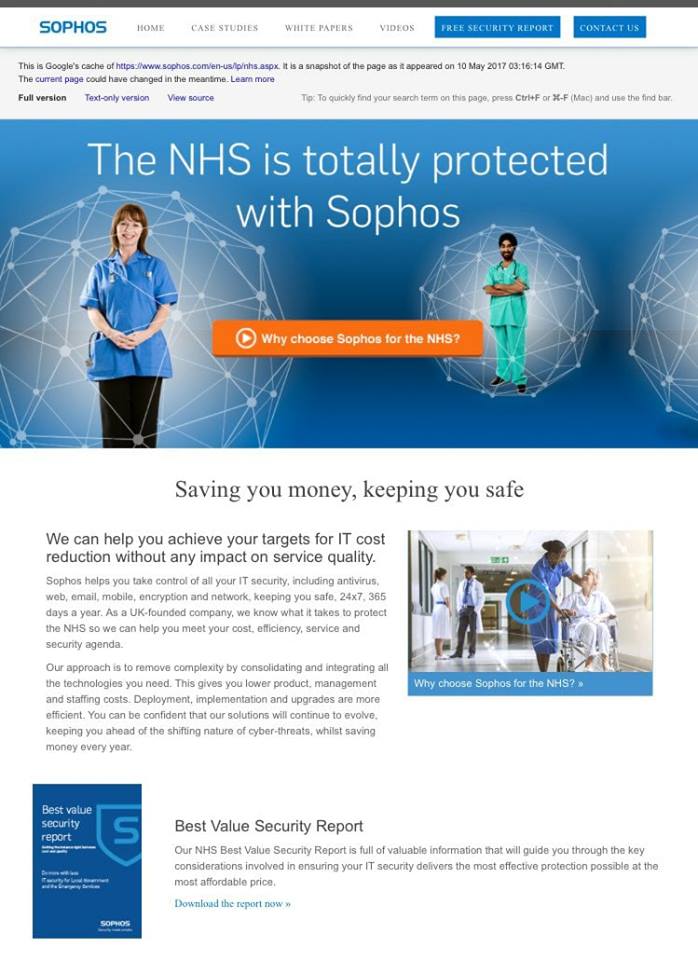
NHS was protected with Sophos (Seems like technologies cannot be trusted? Since, Security is not a product, it's a continuous process)

While working around, I also came to know that, some high profile ISP’s and private organizations of Nepal could be the victims of this ransomware attack campaign. Organizations like Nepal Telecom, Subisu, Worldlink, OTEL, Kantipur Media Group and other more organizations were found to be highly vulnerable to WannaCry Ransomware attack or say, EternalBlue and DoublePulsar exploit attack.
All Windows versions before Windows 10 are vulnerable to ‘WannaCry’ if not patched for MS-17-010. The ransomware worm makes use of EternalBlue MS17-010 to propagate.

EternalBlue, sometimes stylized as ETERNALBLUE, is an exploit developed by the U.S. National Security Agency (NSA). It was released by the Shadow Brokers hacker group on April 14, 2017.

EternalBlue exploits a vulnerability in Microsoft's implementation of the Server Message Block (SMB) protocol. The attackers were able to take advantage of this very vulnerability, exploit and propagate around the globe in a form of ransomware worm.

After the chaotic spread of this ransomware worm, Microsoft also came with an update for Windows XP although End of Life (EOL) for Windows XP was on 8th of April 2014.

But, as of now, the ransomware worm is down, meaning that a researcher and also a blogger by the name MalwareTech has slowed down the cyber-attack by simply registering a domain iuqerfsodp9ifjaposdfjhgosurijfaewrwergwea[.]com, under a name of ‘Botnet Sinkhole’ which acted as a kill switch for the ransomware since the working mechanism of the ransomware was to search for the mentioned domain and if the domain was up, the attack would stop or else continue propagating. However, another researcher (Matthieu Suiche) has also confirmed that he found a new WannaCry variant with a different kill switch and registered new domain ifferfsodp9ifjaposdfjhgosurijfaewrwergwea[.]com However multiple security researches have claimed that there are more samples of the ransomware with different kill-swith and even without any kill-switch function.

As of 14th May, the total of $33,319.59 has been paid. Three bitcoin address were hardcoded into the ransomware itself
(13AM4VW2dhxYgXeQepoHkHSQuy6NgaEb94,12t9YDPgwueZ9NyMgw519p7AA8isjr6SMw, 115p7UMMngoj1pMvkpHijcRdfJNXj6LrLn)

So far, these are the C&C centers found from various sources:

gx7ekbenv2riucmf.onion
57g7spgrzlojinas.onion
xxlvbrloxvriy2c5.onion
76jdd2ir2embyv47.onion
cwwnhwhlz52maqm7.onion

C&C IP address found from various sources:

188[.]166[.]23[.]127:443
193[.]23[.]244[.]244:443
2[.]3[.]69[.]209:9001
146[.]0[.]32[.]144:9001
50[.]7[.]161[.]218:9001
217[.]79[.]179[.]77
128[.]31[.]0[.]39
213[.]61[.]66[.]116
212[.]47[.]232[.]237
81[.]30[.]158[.]223
79[.]172[.]193[.]32
89[.]45[.]235[.]21
38[.]229[.]72[.]16
188[.]138[.]33[.]220

The filetypes that it looks to encrypt are:

.doc, .docx, .xls, .xlsx, .ppt, .pptx, .pst, .ost, .msg, .eml, .vsd, .vsdx, .txt, .csv, .rtf, .123, .wks, .wk1, .pdf, .dwg, .onetoc2, .snt, .jpeg, .jpg, .docb, .docm, .dot, .dotm, .dotx, .xlsm, .xlsb, .xlw, .xlt, .xlm, .xlc, .xltx, .xltm, .pptm, .pot, .pps, .ppsm, .ppsx, .ppam, .potx, .potm, .edb, .hwp, .602, .sxi, .sti, .sldx, .sldm, .sldm, .vdi, .vmdk, .vmx, .gpg, .aes, .ARC, .PAQ, .bz2, .tbk, .bak, .tar, .tgz, .gz, .7z, .rar, .zip, .backup, .iso, .vcd, .bmp, .png, .gif, .raw, .cgm, .tif, .tiff, .nef, .psd, .ai, .svg, .djvu, .m4u, .m3u, .mid, .wma, .flv, .3g2, .mkv, .3gp, .mp4, .mov, .avi, .asf, .mpeg, .vob, .mpg, .wmv, .fla, .swf, .wav, .mp3, .sh, .class, .jar, .java, .rb, .asp, .php, .jsp, .brd, .sch, .dch, .dip, .pl, .vb, .vbs, .ps1, .bat, .cmd, .js, .asm, .h, .pas, .cpp, .c, .cs, .suo, .sln, .ldf, .mdf, .ibd, .myi, .myd, .frm, .odb, .dbf, .db, .mdb, .accdb, .sql, .sqlitedb, .sqlite3, .asc, .lay6, .lay, .mml, .sxm, .otg, .odg, .uop, .std, .sxd, .otp, .odp, .wb2, .slk, .dif, .stc, .sxc, .ots, .ods, .3dm, .max, .3ds, .uot, .stw, .sxw, .ott, .odt, .pem, .p12, .csr, .crt, .key, .pfx, .der


How to be safe?
  • For now, ensure that all Windows-based systems are fully patched. At a very minimum, ensure Microsoft bulletin MS17-010 has been applied.
  • If your organization has SMB publicly accessible via the internet (ports 139, 445) should immediately be blocked for inbound traffics.
  • If your organization is using snort then apply snort 42329-42332, 42340, 41978 rules immediately

These kinds of attacks are also more likely to happen in future, it all starts with just one click of yours so stay safe, stay secure.

At least follow the bellow mentioned points:
  • First and foremost, be sure to back up your most important files on a regular basis.
  • Personalize your anti-spam settings the right way.
  • Refrain from opening attachments that look suspicious.
  • Think twice before clicking.
  • Patch and keep your operating system, antivirus, browsers, Adobe Flash Player, Java, and other software up-to-date.
  • In the event a suspicious process is spotted on your computer, instantly turn off the Internet connection.
  • Keep the Windows Firewall turned on and properly configured at all times.
  • Enhance your protection more by setting up additional Firewall protection.
  • Adjust your security software to scan compressed or archived files, if this feature is available.
  • Consider disabling Windows PowerShell, which is a task automation framework if you do not use it.
  • Disable Macros and ActiveX in Microsoft Office components.
  • Install a browser add-on to block popups as they can also pose an entry point for ransom Trojan attacks.
  • Deactivate AutoPlay.
  • Make sure you disable file sharing.
  • Disable Remote Service if not in use
  • Block known-malicious Tor IP addresses

Wednesday, May 3, 2017

Cyber Threat Intelligence

Threat Intelligence is also sometime known as Cyber Threat Intelligence which is an organized, analyzed and refined information of the potential attack or a way to build a defense in depth strategy for the current attacks that threaten an organization as a whole. Threat intelligence is the most critical component of modern cyber security. By integrating cyber threat intelligence into a security infrastructure, an organization can quickly assess risk, prioritize alters and threats that matters the most, minimize the exposure to attack and save time and money by increasing efficiency of the security operations. These days many companies provide threat intelligence service integrated in the form of Security Information and Event Management (SIEM) to provide real-time analysis of security alerts generated by network hardware and applications.

The use of threat intelligence and SIEM platforms helps organizations understand the risks of the most common and severe threats including internal and especially external threats such as zero day exploits and advanced persistent threats (APT) attacks. In a military, business or security context, intelligence is any information that provides an organization with decision support and possibly a strategic advantage. Threat intelligence is a component of security intelligence and, like security intelligence, includes both the information relevant to protecting an organization from external and internal threats as well as the process, policies and tools designed to gather and analyze the information.

Threat intelligence is however divided into four parts as per the ‘Center for the Protection of National Infrastructure’ which include strategic threat intelligence, tactical threat intelligence, operational threat intelligence and technical threat intelligence.

Strategic Threat Intelligence consists of high-level information which is consumed by senior decision-makers. For example a report indicating that a particular government is believed to have hacked into foreign companies who have direct competitors within their own nation, hence a board might consider this fact when weighing up the benefits and risks of entering that competitive marketplace, and to help them allocate effort and budget to mitigate the expected attacks. Strategic threat intelligence is almost exclusively in the form of reports, briefings or conversations.

Tactical Threat Intelligence often consists of tactics, techniques, and procedures and is the information about how threat actors are conducting attacks. Tactical threat intelligence is gathered by defenders and incident response teams to ensure that their defense, alerting and investigation are prepared for current tactics. For example, the fact that attackers are using tools to obtain clear text credentials and then replaying those credentials is tactical intelligence which could prompt defenders to change policy and prevent interactive logins by admins, and to ensure that logging's do not get captured. Tactical threat intelligence is usually gained by reading white papers or technical press, communicating with peers in other organizations to learn what they are seeing attackers do, or purchasing service from a provider of such intelligence.

Operational Threat Intelligence is the information about specific impending attacks against the organization and is initially consumed by higher level security staff, such as security managers or heads of incident response. Any organization would love to know which groups are going to attack them, when and how, but such intelligence is very rare. In the majority of cases, only a government will have this sort of access to attack groups and their infrastructure necessary to collect this type of intelligence. For national and state threats, it is simply not possible for a private entity to legally gain access to relevant communication channels and hence good operational threat intelligence will not be an option for many organizations.

However, there are cases, where operational intelligence might be available, such as when an organization is targeted by more public actors which include hacktivist. It is advisable for organization to focus on these cases, where details of attacks can be found from open source intelligence or providers with access to closed chat forums. Another form of operational threat intelligence that might be available is that derived from activity based attacks where specific activities or events in the real world result in attacks in the cyber domain. In such instances, future attacks can sometimes be predicted following certain events and event patterns. This linking of attacks to real world events is common practice in physical security but less commonly seen in cyber security.

Technical Threat Intelligence is the information which often consists of data which is normally gathered through technical means. An example would be a feed of internet protocol (IP) addresses suspected of being malicious or implicated as command and control servers. Technical threat intelligence often has a short lifespan since attackers can easily change their IP addresse or modify sum hashes, hence the need to gather such intelligence automatically rises. Technical threat intelligence typically feeds the investigative or monitoring functions of a business, for example blocking attempted connections to suspect servers.

However, cyber threat intelligence is still a new topic and still requires some time to find more information and data regarding the topic. Targeted attacks, zero-day vulnerabilities and malware exploit such as ransom ware attacks are the area of concern for organizations these days, however, the organizations do not have required resources and expertise which is necessary to perform independent research and evaluate these threats. In most of these case threat intelligence services are often used as a form of outsourced capabilities to provide organizations with access to expertise and resources regarding advanced security topics as such, which they might not otherwise be able to afford.

Final Words

Cyber threat intelligence is a complex term and yet unclearly defined, having multifaceted approach to framing, thinking about, and reacting to cyber adversarial activity. Many discussions emphasize the complexity of the cyber operational domain, the speed in which activity and operations take place, in operational level hacktivist group may plan to deface the physical infrastructure as well as cyber infrastructure to support their objective as well as the supposed inherent advantage of the attacker. Threat intelligence should be implemented in every aspect, type and level including strategic level, operational level, tactical level and technical level. Moreover, every emerging threats should be published and should be shared with the global security community so as the threat intelligence can be make globally available and information should be reachable so as to share the knowledge of adversaries on possible cyber-attack.

The main motive behind any cyber-attack depends on type of attack and type of attacker who is attacking. By looking at the basic first steps of an attacker, the type of attack and the targeted point where an attacker is trying to infiltrate can be clearly known and now those information can be immediately put into a place to find out if the attacker will succeed or fail. Usually, honeypots (a decoy server to find out the attack pattern of a hacker) are deployed at such case and help in studying the patterns of an attacker and also help stop attacks. Other than honeypots, to cope against such cyber-attack, threat intelligence can be used as an option for gathering intelligence of an attack in this modern sophisticated cyber domain. Threat intelligence gathers intelligence from various online source, signatures, gathers knowledge of different attack patterns and then verify the original internal and external network traffic and discards the malicious traffic or at cases of zero day attacks gives an alarm to the administrators. Correlating different rule sets in case of SIEM and making a certain rule to gather intelligence about the attack pattern also helps in reducing the threat to some extent.

Tuesday, January 31, 2017

Bypassing eCos Embedded Devices Authentication (CVE-2017-1000020)

Disclaimer: Breaking into unauthorized systems and devices are completely illegal. The information provided here is solely for the purpose of sharing knowledge and all I present is my research materials so that the public can remain safe and benefit from my research.

We have heard a lot of stories about routers being vulnerable to hack attacks, routers being a part of botnet, distributing malwares or lately the story about mirai bot. Let's get into my story here...

Lately, I was working with some router setups on TOTOLINK SOHO router. I performed a router setup and updated my password for my administrator login. After some days I thought of changing some settings and was trying to log into the router but unfortunately I forgot my last password. Instead of pressing the reset button and erasing everything and starting with a fresh setup I thought of taking this issue to some extent and looking into it a bit more. I had heard some stories about public exploits being available for totolink routers. I thought of checking all of them for my benefit and for learning purpose but none of them were of my use. At some times, while I tried to access the router login page there was this one thing that would grab my attention. While trying to access the router login page, 'wizard.htm' (the router setup page) would show up for about 1/2 second or so and then would get redirected to 'login.htm' and if I try to access the 'wizard.htm' page the router would not show it and instead show up the login (login.htm) page again. Untill I clear my browser cache and start the same process again, the process would then show up the same results as before. I thought of looking into this issue and ways for possible login bypass in the authentication mechanism. Looking into the page source code in 'login.htm', showed a line with javascript file named 'language_en.js'. I looked inside it and found the internal page names like 'menu.htm', 'password.htm', 'upload.htm', 'route.htm', and all other pages with heavy information that an attacker would need. Okay, that could come handy later because accessing those pages now would return nothing but the login page again.
 
Main Login page for Totolink Router

If you have been into a bit of networking and stuffs, you probably would know about what a three way handshake is. Generally, Transmission Control Protocol (TCP) uses three way handshake to set up a TCP/IP connection over an Internet Protocol(IP) based network prior to its communication or say exchanging data. I won't be telling you an in-depth story of three way handshake and how that works for now. Let's get back into the story again...

"What if I could stop the process right at the 'wizard.htm' page or may be slow down the process and see what I could do around there?" was the question in my mind.
Okay that sounds fun! but how?

How about performing a slow Denial Of Service (DOS) attack with some play and pause with the device reply?

Wow that sounds much better!

Lets get started...

Hping3 came handy this time. If you don't know what it is then, hping3 is a network tool able to send custom TCP/IP packets and to display target replies just like ping program does with ICMP replies.

I then fired the device with SYN flood attack to execute my slow dos with the use of hping3. By the way SYN flood or FIN flood worked just fine and I never thought of trying other flooding options.

hping3 in FIN flood mode


FIN flood attack in action

So, a SYN flood is a form of denial-of-service attack in which an attacker sends a succession of SYN requests to a target's system in an attempt to consume enough server resources to make the system unresponsive to legitimate traffic.

Now, while the flooding is still taking place go back to your browser, clear your cache (required most of the times), enter the router ip followed by the page you want. Example: ip/reboot.htm or ip/menu.htm and so on. It could take some hit and trial as per the router's capability of resisting the attack but as time passes it would finally give us the page we want to be.

Conclusion: eCos Embedded Web Servers used by Multiple Routers, while sending SYN flood or FIN flood packets fails to validate and handle the packets and does not ask for any sign of authentication resulting in Authentication Bypass.

Shodan Search Result

What could go wrong?
An attacker can take complete advantage of this bug and take over the device remotely or locally.
At the time of writing, there were 11,887 'eCos Embedded Web Servers' as reported by SHODAN but the numbers of internet users using totolink, greatek and other routers not shown by the shodan are likely higher in numbers than as shown in the result. Totolink and Greatek routers were tested and were found vulnerable.

Possibly changing the dns or changing the ip route or changing passwords or updating rogue firmwares or maybe more zombie devices teaming up with the mirai bot army could be the outcome of such vulnerability.

As always, updating the device to the latest firmware version is highly recommended in case of availability. If you find more information related to this bug then feel free to share or exchange ideas.

Thursday, December 29, 2016

Cyber Warfare - How prepared is Nepal?

So, Let me break down every single stuffs and make it easy for you to understand what the topic is about and what's the threat to our country in depth.

What is Cyber Warfare?


The proliferation of internet usage in the recent years has changed the way we interact daily. Right from the usage of e-Commerce, online banking, social networking sites up to connecting every single devices like Internet of things - IOT i.e. toasters, refrigerators, televisions, temperature controls, home automation systems, nuclear power station to internet and controlling them from any end point of globe has been developed. After land, sea, air and space, warfare has entered the fifth domain: cyberspace. Back in the old days, war was fought either from land, sea, air, and space with guns, ammunition, fighter jets, missiles, but now an individual or even a group of individuals can wage a war with just a use of computer and working internet connection, right from their bed while taking a sip of tea and in pajamas.

So, Cyber Warfare is the art and science of fighting without fighting; defeating an opponent without spilling their blood. In other words, cyber war refers to the action by a nation-state, to penetrate other nation’s computers and networks for the purpose of causing damage or disruption.

These days almost all the nation and states are fully dependent on internet for storage and transference of information and information in this era has become a critical part of daily operations. What we say, what we do, what we share, what we plan are very critical information we hold as an individual or as a nation overall and these information could be used against us to malice us.

The Internet was not originally designed with security in mind, but as an open system to allow scientists and researchers to send data to one another quickly. Without strong investments in cyber security and cyber defenses, data systems remain open and susceptible to rudimentary and dangerous forms of exploitation and attack. Since, the internet is widely open and easily accessible by anyone, information can be easily extracted or manipulated and could be used against for espionage, sabotage or vandalism of the national level infrastructures by directly striking to the networks from thousands of miles away and eventually destroying and disrupting the normal flow of information and communication and therefore cyberspace could be the next war-fighting domain in modern warfare.

Let's look at some major attacks around the globe in the past.

Back in the old days (late 80’s and early 90’s), hackers used to break into systems for fun and with motive of learning new things. Robert Tappan Morris, a Cornell University graduate student who released the most notable internet worm also known as ‘Morris worm’ on November of 1988, was where the people started noticing the ability and potential of the internet. Directly or indirectly nation and state sponsored cyber-attack has been going on for more than a decade. The sophistication of cyber-attacks have been evolving in the recent years.

Involvement of China


In 2006, when the China Aerospace Science and Industry Corporation (CASIC) intranet network was surveyed, spywares were found in the computers and later on October 2007, Chines Ministry of State Security stated that foreign hackers had been stealing information from Chinese key areas. The most popular search engine of china, ‘Baidu’ was hacked by Iranian Cyber Army on January of 2010. ‘Operation Aurora’ a series of cyber-attack conducted by china is also among the most notable attack by china against US.


Involvement of Russia


Russia has a tagline of spy, espionage and proxy war since the phase of cold war. On August 2008, computer networks in Georgia were hacked by unknown foreign intruders but around that time US was in conflict with Russia, although there was little or no disruption of services but the hacks did put political pressure on the Georgian government and it appeared to be coordinated with Russian military actions. The most notable attacks carried out by Russian hackers include Red October in 2012, Turla in 2014, Yahoo data breach in 2014, Democratic National Committee (DNC) hack in 2016 and release of Hillary Clinton’s private email has also been blamed upon the Russian hackers although the real source is still unknown or unspoken.

Involvement of others


Among many of the notable attacks, Stuxnet which was discovered in 2010, had targeted industrial control SCADA (Supervisory Control and Data Acquisition) systems in Iran and was blamed on US and Israel, ‘Flame’ in 2012 which appeared to be targeting Iran and middle-eastern countries. ‘Shamoon’ in 2012 was used to conduct an incredibility destructive attack on Saudi oil industry which was blamed on Iran, Sony Pictures hack in 2014 which was blamed on North Korea.

Other than these countries, Belgium, Australia, Maldives, India, Pakistan, Nepal etc. are also the victims of cyber-attacks and are at high risk of massive cyber-attack.

Since, technology is ever changing, and so are cyber threats. Hackers have evolved as per the time. Previously attacks used techniques that were random but now the attack pattern are completely different, sophisticated and more dangerous. Attack are more advanced, persistent and the threats are higher.

What's going on in Nepal?


As per Microsoft’s Malware Infection Index Asia Pacific 2016, Nepal is ranked number four in the list, which means Nepal is extremely vulnerable to cyber-attack and is encountering highest number of malware attack on a daily basis. The Asia Pacific region is especially vulnerable with emerging markets most at risk of malware threats. Out of top five locations across the globe most at risk of infection, a total of four are from the Asia Pacific – Pakistan, Indonesia, Bangladesh and Nepal, topping the ranking at first, second, fourth and fifth place in terms of computer encountering malware.

This is not the first time that Nepal has become a target or being exploited by cyber criminals and state sponsored hackers. Previously, Naikon also known as APT-30 (Advanced Persistent Threat) group has targeted military, government and civil organization and exploited. Carbanak, an APT style attacks also resulted in financial loss of the Nepal including almost thirty other country. These type of attacks are growing rapidly although Nepal has not developed much in terms of technology. Although Nepal has Information Technology Security Emergency Response Team (ITSERT-NP) but does not actively participate in research and development nor do they participate in active Intelligence gathering and learning about new threats and spreading awareness or maybe I could be unaware of that.

Technical manpower who are capable of defending the national level infrastructure are extremely limited and are always outnumbered by start-up hackers. Lack of training, resource, materials and especially security awareness seems to the problem in context of Nepal. The first phase should be divided into learning defensive tactics and then gradually developing offensive techniques and eventually build up elite cyber task force for national defense of information and security of Nepal. On 2014 – 2015 Nepal was highly vulnerable to cyber-attack since the national infrastructure almost collapsed because of the massive earthquake, and as a result, thousands of websites and servers including servers from government, military and private servers were victim of huge cyber-attack and cyber vandalism. The main reason Nepal became a target of cyber attackers was because of the chaos and dilemma caused by earthquake. Most of the websites are built by people who have little or no knowledge about security and on top of that the websites are built for just small amount ranging from minimum of five thousand to fifty thousand rupees. Until and unless the gap between developers and security people are not bridged, cyber-attacks will continue to generate and will be the biggest curse either for Nepalese economy and national infrastructure.

Overall


There is no such thing as hack proof security but still adding extra layer of security and using concept of defense in depth will make attacker to put more effort, time and resource. Since, policy is the first line of defense, a well-structured, and well-formatted and policy should be to the point rather than defining the vague scope of the work. Creating policy for enterprise user as well and end user will help create a wall between enterprise level defenses. Every software and hardware devices should be taken seriously while manufacturing and should be tested before deploying or distributing to the end customers. Public awareness programs helps the public and security related people to discuss on topics that are usually not talked much which will close the gap between security builder and public.

The main motive behind any cyber-attack depends on type of attack and type of attacker who is attacking. By looking at the basic first steps of an attacker, the type of attack and the targeted point where an attacker is trying to attack is clear and now those information can be immediately put in place to find out if the attacker will succeed or fail. Usually, honeypots (a decoy server to find out the attack pattern of a hacker) are deployed at such case and help in studying the patterns of an attacker and also help stop attacks. To cope against cyber-attack, threat intelligence can be used as an option for defense in depth strategy. Threat intelligence gathers intelligence from various online source and then verify the original network traffic and discard the malicious traffic. Correlating different rule sets and making a certain rule to gather intelligence about the attack pattern also helps in reducing the threat to some extent.

To implement security concepts in modern cyber world, training materials and time for the training is limited and the cost is higher for training and on top of that the certifications are for limited period of time. Normally, the certifications of training are for either three years or for four years of limited time period and requires deep understanding of how networks and computers works. For enterprise level security it is somehow easy since there are lots of training resources that are freely available but to spread awareness among the public is a tough task since the public is completely unaware of how the systems work and how they can be used against them. Most people are not focused on the security part of the cyber world but are more interested in buying the latest gadgets and using them for sole benefit or for entertainment purpose.

Final words


No matter how deep is the defense is or how hard you are trained to defend, an attacker will always find a way inside and eventually break into the systems, but that does not mean to do nothing. We can never predict a cyber-war until we start one.

Alan Lakein states a quotation saying, “Failing to plan is planning to fail.”

This statement is indeed true, the very first step in doing any task is planning, and this is true for cyber warfare too. If there is no plan or well written and explained documentation then at the time of incidents, the administrator could not handle the attack and eventually get defeated and would lose data and information worth millions.

A famous quotation by Sun Tzu states, “Victorious warriors win first and then go to war while defeated warriors go to war first and then seek to win.”

This statement is also true in terms of cyber warfare. Before going towards war or before starting a war, a warrior must first know how to defend own self and know the enemy. A drill or an exercise should be carried out to learn the offensive way of penetrating and defensive way of blocking an attack. Offensive and defensive tactics should not be practiced once, nor twice, but a plenty of times before heading towards the real war. Cyber war is not much different than the war in land, sea or air but is the same, where as in cyber warfare there are no bloods and guns but just the computers, network and the giant internet. Recently, ransom wares are evolving day by day and if we do not make the general public aware about the rising malware attacks then the civilians could become direct victim of cyber-attacks.

Past is a lesson, and future is where we implement things we have learned in the past, we can either run away from it or learn a lesson from it. Previous attacks could be of great help to predict future attacks and patterns of attacks. We can expect satellites, naval forces, aircraft, missiles and rockets being hacked and exploited to cause severe damage to the global economy and infrastructures. If we do not prepare now for cyber warfare, develop threat intelligence and prepare defensively then it could raise a massive threats to our lives as a whole.
 
Note:You can find a part of this article published on a Print Media of Nepal at: https://thehimalayantimes.com/opinion/cyber-warfare-how-prepared-is-nepal/ which was published on January 05, 2017 5:06 am On: Opinion